Showing posts with label Iran. Show all posts

Wednesday, January 7, 2015

2015 Will Be All About Iran, China and Russia / Sputnik International

Pepe Escobar

BEIJING, December 31 (Sputnik) — Fasten your seatbelts; 2015 will be a whirlwind pitting China, Russia and Iran against what I have described as the Empire of Chaos.

So yes – it will be all about further moves towards the integration of Eurasia as the US is progressively squeezed out of Eurasia. We will see a complex geostrategic interplay progressively undermining the hegemony of the US dollar as a reserve currency and, most of all, the petrodollar.

For all the immense challenges the Chinese face, all over Beijing it's easy to detect unmistakable signs of a self-assured, self-confident, fully emerged commercial superpower. President Xi Jinping and the current leadership will keep investing heavily in the urbanization drive and the fight against corruption, including at the highest levels of the Chinese Communist Party (CCP). Internationally, the Chinese will accelerate their overwhelming push for new 'Silk Roads' – both overland and maritime – which will underpin the long-term Chinese master strategy of unifying Eurasia with trade and commerce.

Global oil prices are bound to remain low. All bets are off on whether a nuclear deal will be reached by this summer between Iran and the P5+1. If sanctions (actually economic war) against Iran remain and continue to seriously hurt its economy, Tehran’s reaction will be firm, and will include even more integration with Asia, not the West.

No matter how it was engineered, the fact that stands is that the current financial/strategic oil price collapse is a direct attack against (who else?) Iran and Russia.

Washington is well-aware that a comprehensive deal with Iran cannot be reached without Russia’s help. That would be the Obama administration’s sole – and I repeat – sole foreign policy success. A return to the “Bomb Iran” hysteria would only suit the proverbial usual (neo-con) suspects. Still, by no accident, both Iran and Russia are now subject to Western sanctions. No matter how it was engineered, the fact that stands is that the current financial/strategic oil price collapse is a direct attack against (who else?) Iran and Russia.

Complete story at - 2015 Will Be All About Iran, China and Russia / Sputnik International

Thursday, November 13, 2014

The Vineyard of the Saker: Discovering Iran: a travelogue

by Soraya Sepahpour-Ulrich

Marcel Proust once said: “The voyage of discovery is not in seeking new landscapes but in having new eyes.” During the past two decades, I visited Iran on numerous occasions staying 10-14 days at a time. This time around, I stayed for 2 months and heeding Proust, I carried with me a fresh pair of eyes. I discarded both my Western lenses as well as my Iranian lenses and observed with objective eyes. It was a formidable journey that left me breathless.

Part I - Women of the Islamic Republic of Iran

It is hard to know where to start a travel log and how to describe a newfound world in a few pages. However, given the West’s obsession (and the “Westernized” Iranians living abroad) to rescue Iranian women from their perceived “oppression” (while simultaneously imposing illegal and immoral sanctions on them!) perhaps it is appropriate to start with the women in Iran as I perceived them.

Western media with help from feminists and Iranians living outside of Iran portray Iranian women as being “oppressed” -- foremost because women in Iran have to abide by an Islamic dress code - hijab. Yes, hijab is mandatory and women choose to either wear either a chador or to wear a scarf. But what is crucial to understand is the role chador played in pre 1979 versus the post Revolution era.

Prior to the 1979 Revolution, the chador was indicative of a thinly veiled caste system. While a few distinguished women of high socio-economical background chose to wear the chador, the rest, the majority of Iranian women, were simply born into the habit. In short, the socio-economically disadvantaged wore the pre 1979 chador. In those days, the chador was a hindrance to a woman’s progress; she was looked down at and frowned upon. She could not move forward or up. She was oppressed. But Western feminists were blind to this oppression. After all, the Shah was modern and America’s friendly dictator.

The Revolution changed the status quo and chipped away at the caste system. A revolution, by definition, is a complete change in the way people live and work. And so it is with the Iranian Revolution. The post 1979 chador is no longer an impediment to a woman’s future. Today’s Iranian woman, the same (formerly) less privileged class, has found freedom in their chador. They have been unshackled and they march on alongside their (formerly) more privileged colleagues. This emancipation is what the Western/Westernized feminists see as oppression.

I myself come from yesterday’s tiny minority of “privileged” women, far too comfortable in my “Western” skin to want to promote hijab, but I will not allow my personal preferences to diminish the value of the progress made because of hijab. The bleeding hearts from without should simply change their tainted lenses instead of trying to change the lives of others for Iranian women do not need to be rescued, they do not follow – they lead.

Complete story at - The Vineyard of the Saker: Discovering Iran: a travelogue

CC Photo Google Image Search Source is upload wikimedia org  Subject is Flag of Iran WFB 2004

Tuesday, October 14, 2014

Results of the Astrakhan Summit of Caspian States | New Eastern Outlook

The fourth summit of Caspian states, which ended with the signing of the Joint Declaration by the Presidents of the 5 countries, as well as communiques and three agreements governing interactions between Russia, Azerbaijan, Iran, Kazakhstan, and Turkmenistan on the Caspian Sea, was a significant step towards the development of the legal status of this body of water.

Attempts to develop a five-nation Convention on the legal status of the Caspian Sea as a basic document defining issues of jurisdiction over the water area and the bottom, principles of the production of hydrocarbon resources, their transportation routes to world markets, as well as issues of navigation, the use of biological resources of the sea, environmental protection, security, the fight against organized crime and drug trafficking, have been underway for over 20 years now. The process of conciliation has been slow. And here at the Astrakhan Summit they managed to formulate the basic principles that will form the basis of the Convention, which could be signed as soon as 2015, stated the Russian President. The Heads of States, due to increasing security threats in the region in the areas of military, politics, economy, and ecology have shown a willingness to compromise in the search for joint solutions.

Iranian leadership considers the Caspian area one of the priorities of its foreign policy. Nevertheless it is still the Iranian position on the division of the sea that has been the stumbling block in the way of the agreements, Tehran was actively involved in the negotiation process and on a number of matters its approaches to the problems of security, navigation, fishing, protection of biological resources, strengthening of information and cultural humanitarian contacts were close to Russian.

Iranian President Rouhani, summing up the meeting in Astrakhan, as achievements of the summit stressed the importance of the principles enshrined in the policy statement of equal treatment of the security of all the states and their compliance with the principle of “reasonable sufficiency” in the performance of military operations. Iran has been supporting the demilitarization of the Caspian Sea and the agreements reached are considered a step towards curbing the arms race and achieving stability. Iran gives particular importance to the absence of extra-regional forces in the Caspian Sea.

Iran’s interests correspond with those enshrined in the statement of the principle of free access from the Caspian Sea to other seas and oceans.

Complete story at - Results of the Astrakhan Summit of Caspian States | New Eastern Outlook

CaspianSea

Tuesday, October 7, 2014

Isolated? Russia Signs Historic Resource-Sharing Agreement with Caspian Neighbors - Russia Insider

In a monumental move, Russia just sealed a deal with its Caspian neighbors to delineate the disputed maritime borders between them.

This move carries with it enormous geopolitical meaning, and in no particular order, here are some of the most significant results:
Russian Leadership: Russia has demonstrated that it is capable of leading a regional and diverse group of actors to an understanding that even the UN and its Convention on the Law of the Sea couldn’t achieve after over two decades (and to which Azerbaijan and Iran almost went to war over in 2001).

Russian Inclusion: This agreement shatters the narrative that the West has ‘isolated’ Russia, as it is clearly the hegemon in the Caspian, and accordingly, has strong influence over what has been previously forecasted as one of the largest untapped energy regions in the world.

Iranian Opening: All of the cooperative countries in the Caspian are showing that they will cooperate and interact with Iran in this regard, not only opening the avenue for future cooperation in other spheres, but clearly showing that Iran, too, is not isolated
Complete story at - Isolated? Russia Signs Historic Resource-Sharing Agreement with Caspian Neighbors - Russia Insider

CaspianSea

Wednesday, September 10, 2014

Something to "Point At"? - WW III Moving Forward?

Not that you would know it by reading or viewing mainstream news last week, World War III took a very big leap towards going live. First, last Wednesday was the biggest news when Gazprom announced they would be selling oil and gas for rubles and yuan. We knew for a fact this was coming sooner or later, it has arrived. It is so important that you understand what this really means. This is the very first time since 1973 where oil will be traded with public terms NOT being dollars. Yes, Iran is and has been selling oil for gold and euros over the last couple of years but not “publicly” so to speak. Gazprom which is Russia’s equivalent to the American’s ExxonMobil has announced this publicly and as their new policy. As I wrote several weeks back, now you must ask yourself who will follow Gazprom’s example?

The following day (Thursday), there were NATO reports of Russian troops and hardware crossing the Ukraine border. I saw a report of an estimated 20,000 troops, but this link was taken down immediately and I believe it to be false. Russia has continually denied they have troops within sovereign Ukraine. Then came Friday, the U.S. proposed further sanctions and British Prime Minister Cameron proposed locking Russia out of the SWIFT system. Do you see a pattern here? Russia moves step by step further from the dollar which is followed by the West turning the screws tighter to start a live war. We have had several reports of “Russia invading” or “Russian tanks destroyed” and even an airliner actually shot down in an effort to spark war but Mr. Putin refuses so far to take the bait.

Let me switch gears here for a moment and then come back. If you look around the world today, there are many situations big enough to “point at.” What do I mean by “point at?” Think about this, the U.S. and the dollar system is clearly financially upside down and not viable any longer. How would it “look” if all of a sudden one Monday morning the banks and markets did just not open because a panic started? When I say “look,” I am talking about the “perception” to the common man. This cannot be allowed to happen, there absolutely MUST be “something” to point at as the reason or the cause.

What could these reasons or causes be? Are they or will they be real or manufactured? Before listing some possibilities I do want to point out the obvious, the world is (has been) totally interconnected with the use of dollars, banking, financial and trade systems, and of course the $1.4 quadrillion worth of time bombs planted all over the world. A cascade of financial collapse, once started will not be reversible and will take everything with it.

Complete story at - Something to "Point At"?

CC Photo Google Image Search Source is pbs twimg com  Subject is american nazi

Monday, September 1, 2014

The Russia-Iran energy deal may be a losing proposition | Russia Direct

The forthcoming signing of a set of “breakthrough” trade and economic agreements between Russia and Iran may not be the blockbuster economic deal everyone thinks it will be. The unraveling of relations with the West and the forced policy of diversification leaves Russia short of prospective partners, China notwithstanding. Essentially, Russia may have been forced into a deal with Iran that it did not really want.

Economics is still predominantly governed by the law of “opposites attract,” in which regard, Iran and Russia are simply too alike (as strange as it may sound to the patriotic ear) for the new trade partnership to make sense.

First, the two countries possess some of the largest reserves of hydrocarbons anywhere in the world. Second, both Russia and Iran are critically dependent on oil and gas exports. Third and most importantly, they are friends in need, both hit hard by Western sanctions (Iran significantly more so than Russia).

Thus, in world trade (and world politics) Russia and Iran are more like natural competitors than partners. More specifically, Iran is theoretically capable of replacing Russia as the main supplier of gas to European markets, whereupon it is no coincidence that Tehran recently stated its readiness to feed the Nabucco pipeline, a once dead-in-the-water alternative to Russia’s South Stream. Unfortunately, by threatening its neighbors with retaliatory sanctions, Russia continues to push the European Union into the arms of other suitors.

Complete story at - The Russia-Iran energy deal may be a losing proposition | Russia Direct

CC Photo Google Image Search.  Source is upload.wikimedia.org  Subject is Gas Soviet_Union_stamp_1983_CPA_5445.jpg

Friday, August 29, 2014

​Energy ballet: Iran, Russia and 'Pipelineistan' — RT Op-Edge

A fascinating nuclear/energy ballet involving Iran, Russia, the US and the EU is bound to determine much of what happens next in the new great game in Eurasia.

Let’s start with what’s going on with the Iranian nuclear dossier.

Iranian Foreign Ministry legal adviser Jamshid Momtaz has been forced to clarify that the interim nuclear deal signed by Iran and the P-5+1 nations on November 2013 is not an international treaty – yet.

As we stand, the gap between the US, Russia, China, Britain, France and Germany on one side, and Iran on the other side, remains very wide. Essentially, the gap that really matters is between Washington and Tehran. And that, unfortunately, translates as a few more months for the vast sabotage brigade – from US neo-cons and assorted warmongers to Israel and the House of Saud – to force the deal to collapse.

One of Washington’s sabotage mantras is “breakout capability”; a dodgy concept which boils down to total centrifuge capacity/capability to produce enough enriched uranium for a single nuclear bomb. This implies an arbitrary limit on Iran’s capacity to enrich uranium.

The other sabotage mantra forces Iran to shut down the whole of its uranium enrichment program, and on top of it negotiate on its missiles. That’s preposterous; missiles are part of conventional armed forces. Washington in this instance is changing the subject to missiles that might carry the nuclear warheads that Iran does not have. So they should also be banned.

Moscow and Beijing see “breakout capability” for what it is; a manufactured issue. While Washington says it wants a deal, Moscow and Beijing do want a deal – stressing it can be respected via strict monitoring.

Complete story at - ​Energy ballet: Iran, Russia and 'Pipelineistan' — RT Op-Edge

CC Photo Google Image Search Source is www lngworldnews com  Subject is Myanmar China Gas Pipeline Officially Inaugurated

Wednesday, August 27, 2014

Russia steps up economic collaboration with Iran | Russia Direct

by Olga Malikova

In September, Russia and Iran plan to sign a set of bilateral agreements on trade and economic cooperation. The two countries are also expected to discuss the recently signed memorandum of mutual understanding, which provides for the delivery to Iran of Russian equipment and consumer goods in exchange for Iranian oil. Despite the threat of fresh U.S. sanctions against Iran if the deal with Russia goes ahead, Tehran is looking to strengthen cooperation with Moscow.

The bilateral memorandum signed on August 5 provides for the expansion of trade and economic cooperation in the fields of energy and energy-related infrastructure, particularly the oil and gas sector, as well as “the supply of machinery, equipment, consumer goods, and agricultural products.” In exchange, Iran will ship 500,000 barrels of oil per day in the other direction. Specific contracts and agreements could be signed during the meeting of the intergovernmental commission slated for September 9-10 in Tehran.

Moscow believes that the agreement could have a significant impact on the economic development of both countries. Russia, in particular, is attracted by the prospect of greater access to Iran’s highly promising hydrocarbon reserves.

Moreover, by the Kremlin’s logic, Russian companies will have more opportunities to increase exports of their high-tech equipment abroad.

In recent years, many experts have noted a rising imbalance in oil exports from Russia and the country’s proven reserves. Russia is second only to Saudi Arabia as a supplier of oil to the world market, but its proven reserves are not so vast.

Russia’ proven reserves are a mere 93 billion barrels, to be precise, or 5.5 percent of the world's proven oil reserves. Many fields in Russia have peaked, and new deposits are located in complex geological and climatic conditions.

Complete story at - Russia steps up economic collaboration with Iran | Russia Direct

Wednesday, July 23, 2014

M of A - Iran: The Nuclear Negotiations Scam

Four "western" Foreign Ministers flew to Vienna today to further negotiate about Iran's nuclear achievements. It is quite dubious why Kerry thought that such a meeting now would be helpful. It looks like this was planned as an attempt to intimidate Iran into further concessions but failed because neither Russia's nor China's Foreign Minister are attending.

The negotiations are supposed to find a compromise until July 20. After that the negotiations would have to be prolonged for another 6 month which would only give more time to those who are against any deal to sabotage it.

The two sticking points are "breakout capacity" and the length of the period Iran would restrict itself to a certain limits of its industrial nuclear capacities. The "breakout capability" is a quite weird concept described as the total centrifuge capacity and thereby capability to produce enough enriched Uranium for one sole bomb in a certain time frame. Of course no state wanting a nuclear deterrent would use its officially declared, and highly controlled capacities to produce the materials needed. Nor would the reach of a "one bomb" capability be significant in any strategic sense.

But the U.S. negotiators seem to stick to the concept of arbitrarily limiting enrichment capabilities while even very seasoned U.S. proliferation experts find that it not helpful and that it risks to make any deal impossible:

So the most realistic goal in Vienna isn’t to make breakout impossible, but to make it a difficult and unattractive option for Iran. Once you see that as the goal, you realize that the gains in transparency from any likely deal—extremely close monitoring of declared facilities and the power to inspect undeclared facilities—should be at the forefront of American thinking about this problem. It would be a mistake to sacrifice such transparency in a failed attempt to reduce Iran’s breakout capacity by some arbitrary increment that is actually less valuable than many in Washington think it is.

Complete story at - M of A - Iran: The Nuclear Negotiations Scam

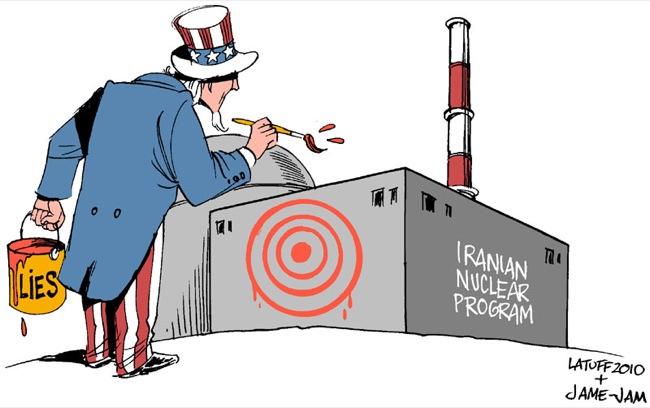
CC Photo Google Image Search Source is fc08 deviantart net  Subject is Targeting Iran nuclear program by Latuff2

Thursday, April 10, 2014

US Threatens Russia Over Petrodollar-Busting Deal | Zero Hedge

On the heels of Russia's potential "holy grail" gas deal with China, the news of a Russia-Iran oil "barter" deal, it appears the US is starting to get very concerned about its almighty Petrodollar

*U.S. HAS WARNED RUSSIA, IRAN AGAINST POSSIBLE OIL BARTER DEAL
*U.S. SAYS ANY SUCH DEAL WOULD TRIGGER SANCTIONS
*U.S. HAS CONVEYED CONCERNS TO IRANIAN GOVT THROUGH ALL CHANNELS

We suspect these sanctions would have more teeth than some travel bans, but, as we noted previously, it is just as likely to be another epic geopolitical debacle resulting from what was originally intended to be a demonstration of strength and instead is rapidly turning out into a terminal confirmation of weakness.

As we explained earlier in the week,

Russia seems perfectly happy to telegraph that it is just as willing to use barter (and "heaven forbid" gold) and shortly other "regional" currencies, as it is to use the US Dollar, hardly the intended outcome of the western blockade, which appears to have just backfired and further impacted the untouchable status of the Petrodollar.

...

"If Washington can't stop this deal, it could serve as a signal to other countries that the United States won't risk major diplomatic disputes at the expense of the sanctions regime,"

Complete story at - US Threatens Russia Over Petrodollar-Busting Deal | Zero Hedge

Tuesday, April 8, 2014

Blowback: the making of an anti-US coalition | OpEdNews

In intelligence parlance, a blowback is an unexpected and adverse consequence of a covert operation. The Iranian Mullah regime may be viewed as a blowback of the CIA's coup d'etat removing Prime Minister Mossadegh from office in 1953.

A tenet of international relations is the balance of power. To achieve a lasting peace, a powerful nation may not abuse its power. Napoleon learned it the hard way. Bismarck was wiser. After his victory over France, having achieved his objective of uniting Germany around Prussia, he played a balancing act with its two powerful neighbors, the Habsburgs and the Romanovs. To preserve his gains, he needed peace. A powerful nation, blindly pursuing a hegemonic policy, will entice a reaction in the form of a coalition against itself. The United States is a powerful nation. It is at a crossroads. It may either take advantage of its power to attain world domination, or endeavor to achieve peace through "collective actions" and international cooperation', as stipulated in the United Nations' charter.

A push for hegemony

Whatever Obama may say about European history, the Enlightenment, and the birth of the United States as he did in his Brussels speech on March 26, his country's policy, domestic and foreign, violates the United Nations' charter and perverts the American Constitution (e.g. Patriot Act, Guantanamo, NSA surveillance, Swat teams, whistleblower hunt, Afghanistan war, Iraq invasion, Libya's destruction, drones attacks, etc.). Documents such as The New American Century or The National Security Strategy of the United States (2002) not to mention Zbigniew Brzezinski's "The Grand Chessboard", leave little doubt as to the road the United States pursues. The policy is a covert operation. The American public, the man in the street, is unaware of it.

The United States' first target is Russia. As noted by Jack F. Matlock Jr., former American ambassador to the Soviet Union (1987-1991), "the U.S. has treated Russia like a loser since the end of the Cold War". (1) Vladimir Putin, as the leader of a nation whose roots go far back in history, sees it as his duty to resist such a treatment.

Complete story at - Blowback: the making of an anti-US coalition | OpEdNews

Monday, April 7, 2014

W(h)ither Petrodollar: Russia, Iran Announce $20 Billion Oil-For-Goods Deal | Zero Hedge

Spot what is missing in the just blasted headline from Bloomberg:

IRAN, RUSSIA SAID TO SEAL $20B OIL-FOR-GOODS DEAL: REUTERS

If you said the complete absence of US Dollars anywhere in the funds flow you are correct. Which is precisely what we have been warning would happen the more the West and/or JPMorgan pushed Russia into a USD-free corner.

Once again, from our yesterday comment on the JPM Russian blockade: "what JPM may have just done is launch a preemptive strike which would have the equivalent culmination of a SWIFT blockade of Russia, the same way Iran was neutralized from the Petrodollar and was promptly forced to begin transacting in Rubles, Yuan and, of course, gold in exchange for goods and services either imported or exported. One wonders: is JPM truly that intent in preserving its "pristine" reputation of not transacting with "evil Russians", that it will gladly light the fuse that takes away Russia's choice whether or not to depart the petrodollar voluntarily, and makes it a compulsory outcome, which incidentally will merely accelerate the formalization of the Eurasian axis of China, Russia and India?"

In other words, Russia seems perfectly happy to telegraph that it is just as willing to use barter (and "heaven forbid" gold) and shortly other "regional" currencies, as it is to use the US Dollar, hardly the intended outcome of the western blocakde, which appears to have just backfired and further impacted the untouchable status of the Petrodollar.

Complete story at - W(h)ither Petrodollar: Russia, Iran Announce $20 Billion Oil-For-Goods Deal | Zero Hedge

Recommended Reading via Amazon


If you're seeking more information about how the world really works, and not how the media would want you to believe it works, these books are a good start. These are all highly recommended.

If you don't see pictures above, you likely have an adblocker running.  If so, here are the links.

1. The Shock Doctrine - Naomi Klein
2. Confessions of an Economic Hit Man - John Perkins
3. Manufacturing Consent - Edward Herman, Noam Chomsky
4. Gladio - NATO's Dagger at the Heart of Europe - Richard Cottrell
5. Profit Over People - Noam Chomsky
6. Soviet Fates and Lost Alternatives - Stephen Cohen
7. The Divide - American Injustice in the Age of the Wealth Gap - Matt Taibbi

How this works.  Follow one of the links.  Should you decide to buy that item, or any item, I get a small percentage, which helps to maintain this site.  Your cost is the same, whether you buy from my link or not.  But if the item remains in the cart too long, I don't get a thing.  
Related Posts Plugin for WordPress, Blogger...