By Timothy Holtgrefe - July 11, 2014
State efforts to promote propaganda messages to their populations are certainly not new in history. Most are probably familiar with WWII propaganda posters vilifying the enemy, or promoting support for the war effort. There is a whole wealth of literature dedicated to Hitler’s use of propaganda to control the minds of his people in his rise to power.
Today, many accusations of propaganda are alleged. In the current reporting of the Ukraine crisis, global audiences are confused over the discrepancies in the news coverage coming from different media outlets. In April 2014, US Secretary of State John Kerry called Russia Today a “propaganda bullhorn” for Vladimir Putin. RT and others charged back that Fox News and CNN are full of corporate bias. If the coverage from multiple sources is examined objectively, it cannot be denied that there is an obvious information war. The question is a war against whom and for what purpose? Luckily, many researchers have studied state efforts to control the minds of their populations and history provides great documentation to shed light on the issue. The historical evidence shows propaganda is a necessary tool, for power is only tolerable through obedience and consent. Throughout the ages, this obedience or consent has been carried out through a variety of methods. These methods included religious appeal, nationalism, fear, and—most particularly—mass deception.
Religious Appeal
Perhaps the easiest and most historically well-known weapon to control the masses has been religion. Contrary to whatever message Jesus, Mohammed, or Buddha meant to empower common people, elites have historically abused religious institutions and dogmas to justify social inequality and their right to rule. One of the most telling examples of this method in use was described by Titus Livy’s The History of Rome. The Roman Republic (509-27BC) was an oligarchy ruled by an elite political class known as the Patricians, or nobles. By limiting participation in government to only themselves, they ensured preservation of their power. For a while, only Patrician families had representatives in the Republic until the commoners, or Plebeians, created the office outside of the Senate called the Tribune. Plebeians would push for even greater voice in their government by adding consular power as a direct challenge to the Patrician nobles. To counter this threat, the elite used the religious dogma of the time, as Livy writes in The History of Rome, Book 4, “There occurred in that year pestilences and famine. Availing themselves of this opportunity in the next election of tribunes, the nobles said that the gods were angry with Rome for having abused the majesty of her authority, and the only way to placate them was to restore the election of tribunes to its ‘proper’ position.” The result was that the Plebs, terrified of this appeal to the gods, appointed only nobles as tribunes.
To further make the point, many of the privileged families of Rome claimed ancestry from gods as part of their prestige. Julius Caesar was of the Julii family, who claimed ancestry from the god, Venus. Elsewhere in the world, the Emperors of Japan were direct descendants of the sun god, Western royalty held the Divine Right of Kings, and Emperors of China affirmed a Mandate of Heaven. In India, the religious model for reincarnation has justified the staunch social inequalities of the Caste system. In this example, it was culturally assumed that elite families were rewarded for their deeds in their past lives, and the poor committed very terrible sins in theirs; hence warranting their life of slavery. These patterns of religious appeal to the masses to justify social inequality and authority are predictable throughout world history.
The Foundations of Propaganda
Art, sculptures, and architecture have always served to project propaganda through images; however, with the birth of mass literacy and prolific publications, consent to authority would call for a more persuasive approach within the available literature to the public. The greatest challenge to ruling European elites in 19th century was the revolutionary zeal following the French Revolution. Across the board, rulers were forced to grant more and more concessions to the masses as old power began to decline. Like the Plebeians over two thousand years before, people demanded more direct representation in government. As newspapers became more prolific, the power of ideas and words became apparent; hence the beginning of the information war. Throughout the Industrialized world, news coverage benefiting the needs of the ruling elite and imperialism were promoted, and words challenging ruling authority were considered seditious. As early as the 18th century, in the doctrine of seditious libel, truth was no defense. Thanks to cultural indoctrination and war propaganda, America was able to fulfill its “Manifest Destiny” that harbored many religious and nationalist overtones, which the press helped to promote. In publications throughout the period, the United States was not an aggressive invading force, but rather defending itself from the evil Indian savages, Mexicans, and Spanish to justify greater land expansion. In the Early 20th Century, erudite intellectuals would later praise themselves and Woodrow Wilson for having imposed their will upon a reluctant public majority to participate in WW1 with the aid of propaganda, fabrications about German atrocities, and other such devices. Fifteen years after WWI, Harold Lasswell explained in the Encyclopedia of Social Sciences that “we should not succumb to democratic dogmatisms about men being the best judges of their own interests.” In other words, they are not. Within the sociological literature of the time, it was more or less assumed that the best judges are the elites, who must, therefore, impose their will for the common good. Using classic historical tactics, Woodrow Wilson’s Red Scare demolished unions and other dissident elements. A prominent feature of the time was the suppression of independent politics and free speech. Wilson’s Creel Commission, dedicated to creating war fever among the pacifist public, had demonstrated the efficiency of organized propaganda with the cooperation of loyal media and intellectuals. The commission judged, “one of the best means of controlling news was flooding news channels with ‘facts’ or what amounted to official information.” After WWII, historian Thomas Bailey observed that because the will of the masses cannot be trusted to guide the common good, “our statesmen are forced to deceive them into an awareness of their own long-run interests. Deception of the people may in fact become increasingly necessary.”
Complete story at - The History of Propaganda - THE HISTORIAN'S QUARTERLY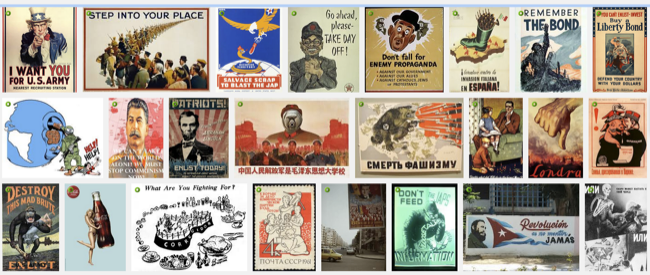
State efforts to promote propaganda messages to their populations are certainly not new in history. Most are probably familiar with WWII propaganda posters vilifying the enemy, or promoting support for the war effort. There is a whole wealth of literature dedicated to Hitler’s use of propaganda to control the minds of his people in his rise to power.
Today, many accusations of propaganda are alleged. In the current reporting of the Ukraine crisis, global audiences are confused over the discrepancies in the news coverage coming from different media outlets. In April 2014, US Secretary of State John Kerry called Russia Today a “propaganda bullhorn” for Vladimir Putin. RT and others charged back that Fox News and CNN are full of corporate bias. If the coverage from multiple sources is examined objectively, it cannot be denied that there is an obvious information war. The question is a war against whom and for what purpose? Luckily, many researchers have studied state efforts to control the minds of their populations and history provides great documentation to shed light on the issue. The historical evidence shows propaganda is a necessary tool, for power is only tolerable through obedience and consent. Throughout the ages, this obedience or consent has been carried out through a variety of methods. These methods included religious appeal, nationalism, fear, and—most particularly—mass deception.
Religious Appeal
Perhaps the easiest and most historically well-known weapon to control the masses has been religion. Contrary to whatever message Jesus, Mohammed, or Buddha meant to empower common people, elites have historically abused religious institutions and dogmas to justify social inequality and their right to rule. One of the most telling examples of this method in use was described by Titus Livy’s The History of Rome. The Roman Republic (509-27BC) was an oligarchy ruled by an elite political class known as the Patricians, or nobles. By limiting participation in government to only themselves, they ensured preservation of their power. For a while, only Patrician families had representatives in the Republic until the commoners, or Plebeians, created the office outside of the Senate called the Tribune. Plebeians would push for even greater voice in their government by adding consular power as a direct challenge to the Patrician nobles. To counter this threat, the elite used the religious dogma of the time, as Livy writes in The History of Rome, Book 4, “There occurred in that year pestilences and famine. Availing themselves of this opportunity in the next election of tribunes, the nobles said that the gods were angry with Rome for having abused the majesty of her authority, and the only way to placate them was to restore the election of tribunes to its ‘proper’ position.” The result was that the Plebs, terrified of this appeal to the gods, appointed only nobles as tribunes.
To further make the point, many of the privileged families of Rome claimed ancestry from gods as part of their prestige. Julius Caesar was of the Julii family, who claimed ancestry from the god, Venus. Elsewhere in the world, the Emperors of Japan were direct descendants of the sun god, Western royalty held the Divine Right of Kings, and Emperors of China affirmed a Mandate of Heaven. In India, the religious model for reincarnation has justified the staunch social inequalities of the Caste system. In this example, it was culturally assumed that elite families were rewarded for their deeds in their past lives, and the poor committed very terrible sins in theirs; hence warranting their life of slavery. These patterns of religious appeal to the masses to justify social inequality and authority are predictable throughout world history.
The Foundations of Propaganda
Art, sculptures, and architecture have always served to project propaganda through images; however, with the birth of mass literacy and prolific publications, consent to authority would call for a more persuasive approach within the available literature to the public. The greatest challenge to ruling European elites in 19th century was the revolutionary zeal following the French Revolution. Across the board, rulers were forced to grant more and more concessions to the masses as old power began to decline. Like the Plebeians over two thousand years before, people demanded more direct representation in government. As newspapers became more prolific, the power of ideas and words became apparent; hence the beginning of the information war. Throughout the Industrialized world, news coverage benefiting the needs of the ruling elite and imperialism were promoted, and words challenging ruling authority were considered seditious. As early as the 18th century, in the doctrine of seditious libel, truth was no defense. Thanks to cultural indoctrination and war propaganda, America was able to fulfill its “Manifest Destiny” that harbored many religious and nationalist overtones, which the press helped to promote. In publications throughout the period, the United States was not an aggressive invading force, but rather defending itself from the evil Indian savages, Mexicans, and Spanish to justify greater land expansion. In the Early 20th Century, erudite intellectuals would later praise themselves and Woodrow Wilson for having imposed their will upon a reluctant public majority to participate in WW1 with the aid of propaganda, fabrications about German atrocities, and other such devices. Fifteen years after WWI, Harold Lasswell explained in the Encyclopedia of Social Sciences that “we should not succumb to democratic dogmatisms about men being the best judges of their own interests.” In other words, they are not. Within the sociological literature of the time, it was more or less assumed that the best judges are the elites, who must, therefore, impose their will for the common good. Using classic historical tactics, Woodrow Wilson’s Red Scare demolished unions and other dissident elements. A prominent feature of the time was the suppression of independent politics and free speech. Wilson’s Creel Commission, dedicated to creating war fever among the pacifist public, had demonstrated the efficiency of organized propaganda with the cooperation of loyal media and intellectuals. The commission judged, “one of the best means of controlling news was flooding news channels with ‘facts’ or what amounted to official information.” After WWII, historian Thomas Bailey observed that because the will of the masses cannot be trusted to guide the common good, “our statesmen are forced to deceive them into an awareness of their own long-run interests. Deception of the people may in fact become increasingly necessary.”
Complete story at - The History of Propaganda - THE HISTORIAN'S QUARTERLY


